
Overview
Agentic Fraud Reasoning – Overview
Agentic Fraud Reasoning is an AI-assisted document fraud analysis feature that helps admins review submitted documents for potential fraud risk.
It analyzes documents and produces a structured fraud assessment that can include a fraud score, decision, confidence level, reasoning, red flags, evidence, recommendations, and summaries from the agents involved in the analysis.
Agentic Fraud Reasoning is designed to help compliance, risk, operations, and document review teams understand why a document may require attention, not just whether it passed or failed a check.
What Agentic Fraud Reasoning does
Agentic Fraud Reasoning reviews submitted documents and provides a fraud assessment with supporting reasoning.
The result can help admins:
- identify documents that may require closer review
- understand suspicious indicators found during analysis
- compare the fraud score with the reasoning and evidence provided
- decide whether a document should be accepted, rejected, or reviewed manually
- reduce the amount of manual investigation needed for low-risk or clearly suspicious documents
Agentic Fraud Reasoning does not replace human judgment. It provides AI-assisted analysis that should be reviewed together with the document, workflow context, and any other verification results available in Bynn.
How it fits into document review
Agentic Fraud Reasoning is running automatically after a document has been submitted and analyzed by Bynn’s document processing and fraud detection pipeline.
At a high level, the process is:
- A document is submitted.
- Bynn processes the document.
- Standard document fraud checks are completed.
- Agentic Fraud Reasoning will run an additional AI-assisted analysis.
- The result is shown to admins in the dashboard.
This gives reviewers both structured fraud results and plain-language reasoning that explains the assessment.
Orchestrator Agents and Fraud Analysis Agents
Agentic Fraud Reasoning uses two main concepts:
| Concept | Purpose |
|---|---|
| Orchestrator Agent | Coordinates fraud analysis for selected document types and works with assigned fraud analysis agents. |
| Fraud Analysis Agent | Performs a specific fraud analysis task or investigation role as part of the assessment. |
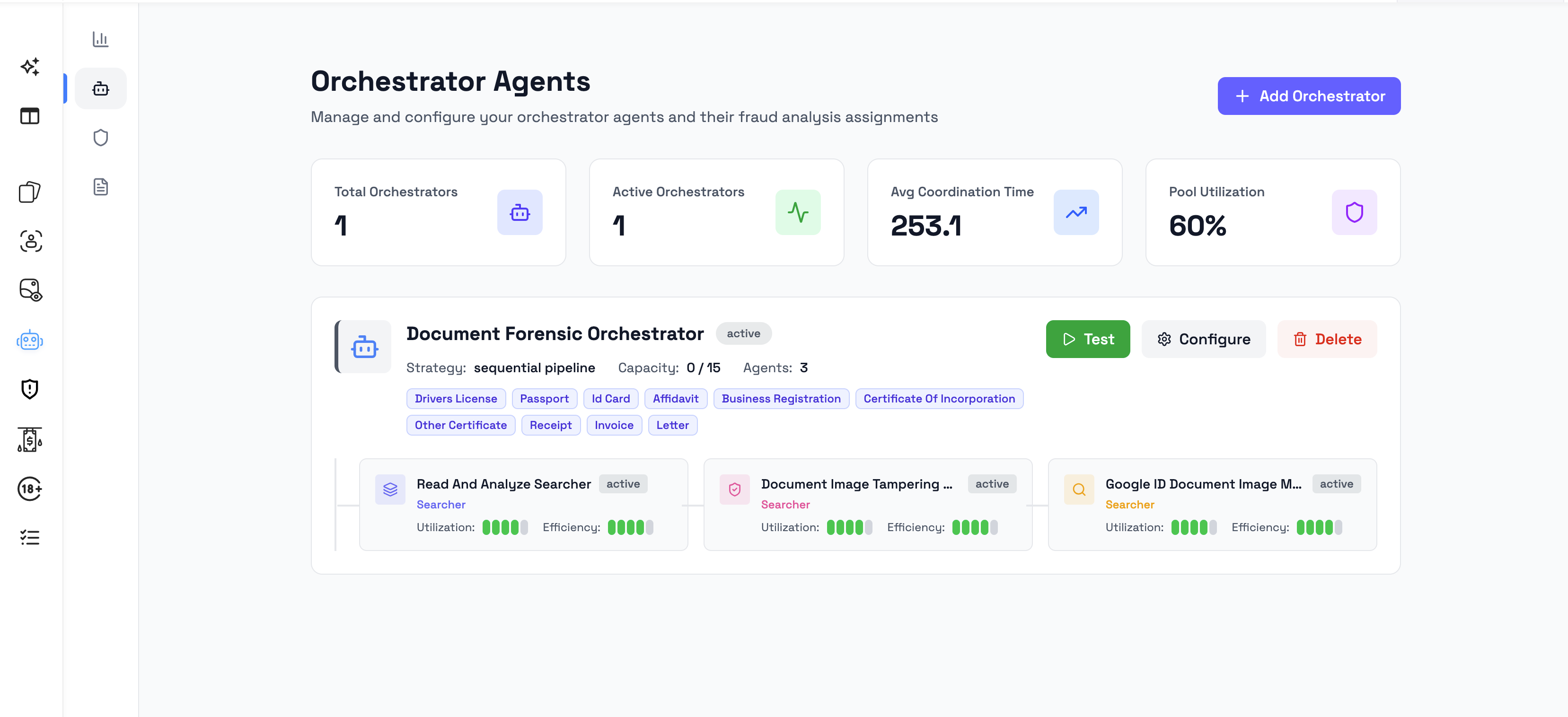
An Orchestrator Agent can be assigned to document types such as passports, ID cards, or driver licenses. It coordinates the analysis and uses assigned Fraud Analysis Agents to produce a structured result.
A Fraud Analysis Agent focuses on a specific type of analysis. For example, an agent may be configured as a searcher or crawler depending on its role in the fraud analysis process.
Detailed configuration is covered in the Orchestrator Agents and Fraud Analysis Agents guides.
Where Agentic Fraud Reasoning appears
Agentic Fraud Reasoning can appear in several areas of the dashboard, depending on the workspace configuration.
Common areas include:
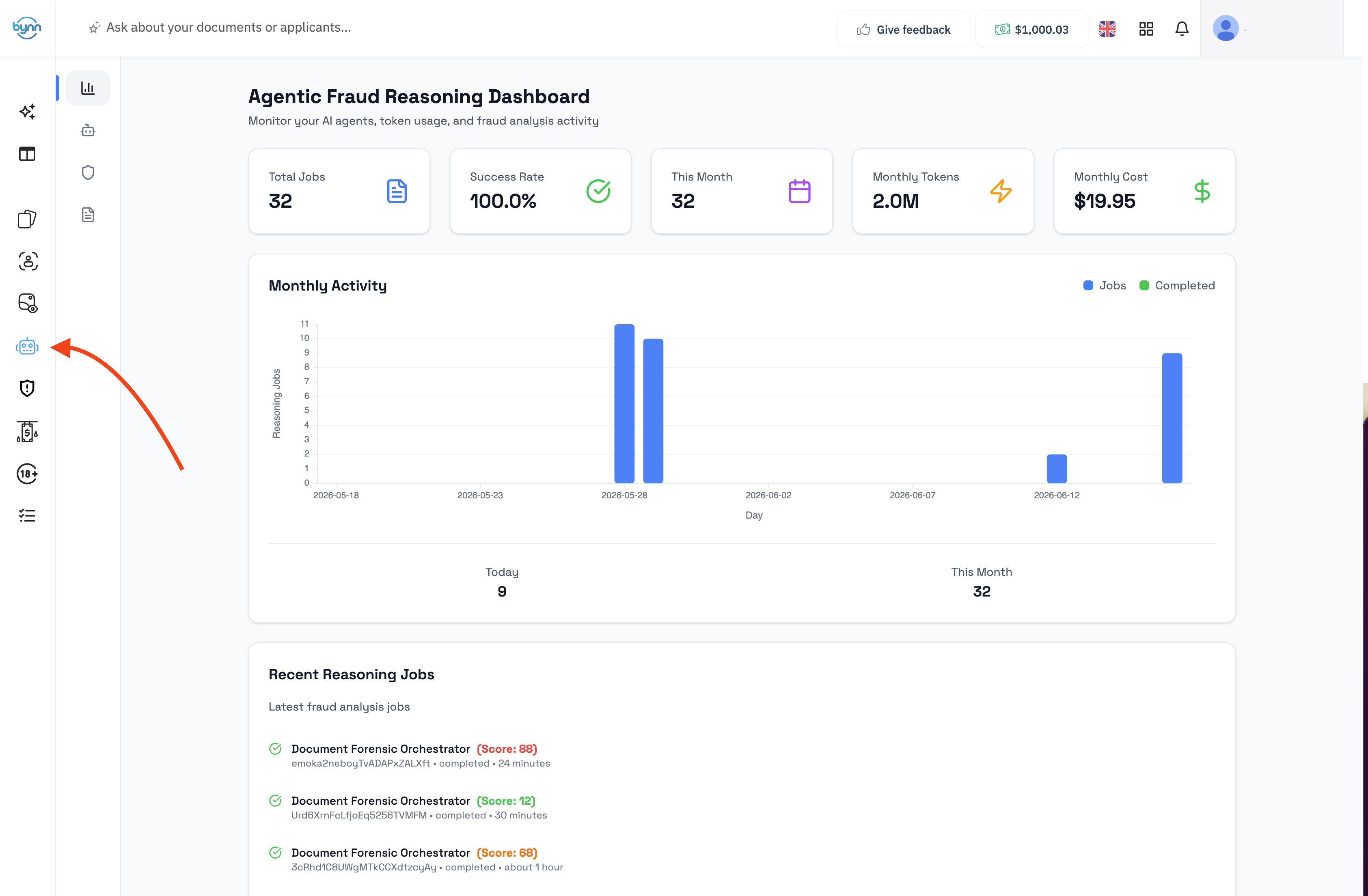
- the Agentic Fraud Reasoning dashboard area
- document detail views where fraud reasoning results are shown
- configuration areas where agents or orchestrators are managed
The main dashboard pages help admins manage the available fraud analysis agents, configure orchestrators, and review how agents are assigned.
What results it produces
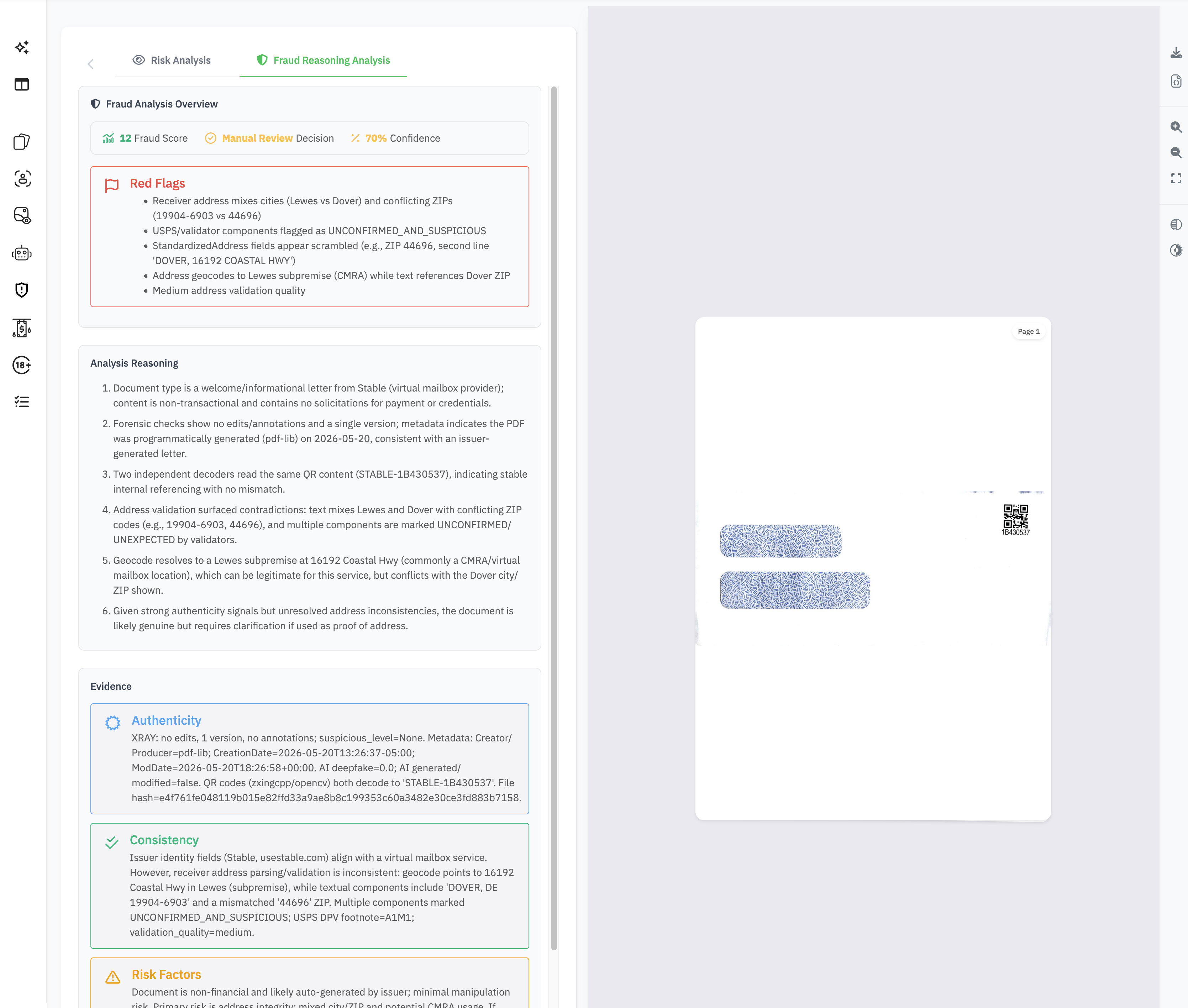
A completed Agentic Fraud Reasoning analysis can include:
| Result | Description |
|---|---|
| Fraud Score | A numeric indicator of assessed fraud risk. Higher scores indicate higher risk. |
| Decision | A suggested outcome, such as accept, reject, or manual review. |
| Confidence | How confident the analysis is in the assessment. |
| Reasoning | Plain-language explanation of why the result was produced. |
| Red Flags | Suspicious indicators identified during analysis. |
| Evidence | Supporting information used to explain the result. |
| Recommendations | Suggested next steps for review or follow-up. |
| Operator Summary | Summary of findings from the fraud analysis agents involved. |
These results are intended to help admins understand the fraud assessment and decide what action should be taken.
Detailed result interpretation is covered in the Understanding fraud analysis results guide.
How it differs from related Bynn features
Agentic Fraud Reasoning works alongside other Bynn document features, but it has a different purpose.
| Feature | Main purpose |
|---|---|
| Document Fraud Detection | Performs standard fraud checks on submitted documents. |
| Agentic Fraud Reasoning | Adds AI-assisted reasoning, evidence, and explanation around fraud risk. |
| AI Agent Validation | Checks whether a submitted document meets configured acceptance or rejection criteria. |
| Document Data Extraction | Extracts configured values from documents and saves them as workflow data. |
In simple terms:
- Document Fraud Detection checks the document for fraud indicators.
- Agentic Fraud Reasoning explains and reasons about fraud risk.
- AI Agent Validation checks whether the document meets configured rules.
- Document Data Extraction reads values from the document.
Detailed comparisons are covered in the Relationship to other Bynn features guide.
When to use Agentic Fraud Reasoning
Use Agentic Fraud Reasoning when your team needs more context around document fraud risk than a basic score or pass/fail result can provide.
It is especially useful when reviewers need to understand:
- why a document was flagged
- which indicators contributed to the result
- whether a document should be escalated to manual review
- how confident the analysis is
- what supporting evidence was found
Agentic Fraud Reasoning is best used as part of a broader review process that may also include document fraud checks, identity verification, document validation, and manual review.
Important limitations
Agentic Fraud Reasoning is AI-assisted and should not be treated as a guarantee that a document is genuine or fraudulent.
Customers should keep the following in mind:
- fraud scores and decisions are assessments, not legal conclusions
- high-risk or unclear results should be reviewed by a human
- low-risk results do not guarantee that a document is authentic
- document quality, completeness, and readability can affect analysis quality
- results should be considered together with other verification data and workflow context
For high-impact decisions, use Agentic Fraud Reasoning as decision support rather than the only basis for approval or rejection.
Updated 3 months ago