
Understanding Fraud Resoning Results
Agentic Fraud Reasoning results help admins understand the overall fraud assessment, the findings produced by individual Fraud Analysis Agents, and the evidence supporting the final conclusion. The results are available in the document detail (Document Fraud Detection) view under Fraud Reasoning Analysis and are separate from the standard Risk Analysis result.
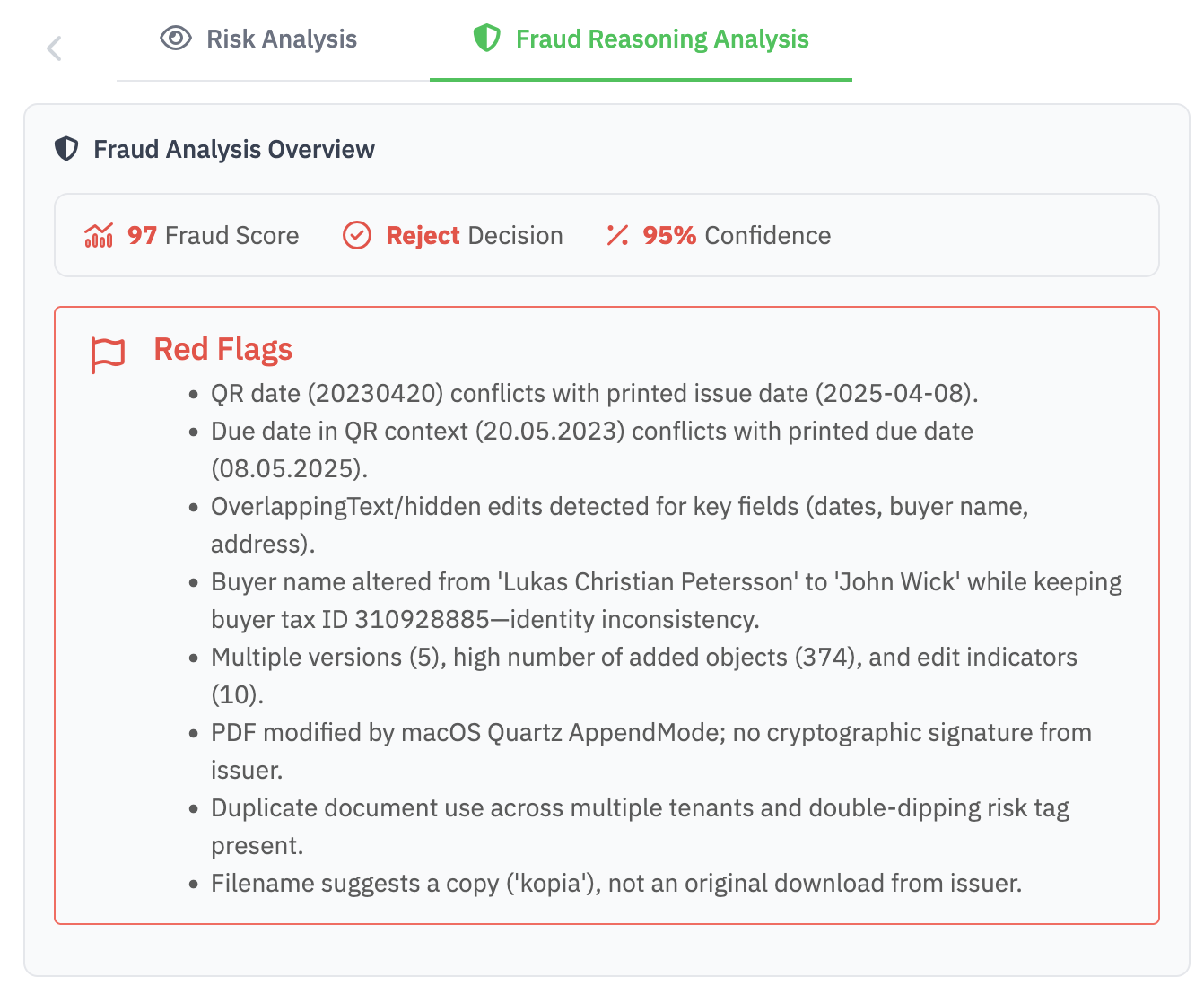
Result overview
The Fraud Analysis Overview summarizes the final outcome of the analysis. It contains:
- Fraud Score
- Decision
- Confidence
- Red Flags These fields provide a high-level summary before the detailed operator findings, reasoning, evidence, and recommendations are reviewed.
Fraud Score
The Fraud Score represents the overall level of fraud risk identified by Agentic Fraud Reasoning. The score ranges from 1 to 100.
- A lower score indicates lower identified fraud risk.
- A higher score indicates greater identified fraud risk. The Fraud Score should be reviewed together with the decision, confidence level, red flags, and supporting evidence. It is separate from any score shown in the standard Risk Analysis tab. Bynn does not require fixed score ranges to be interpreted as automatically acceptable or unacceptable. The context and supporting findings should also be reviewed.
Decision
The Decision presents the final conclusion produced by Agentic Fraud Reasoning. The possible decisions are:
| Decision | Meaning |
|---|---|
| Accept | The analysis did not identify sufficient concerns to recommend rejection or manual review. |
| Reject | The analysis identified significant concerns that support rejecting the document. |
| Manual Review | The available information is inconclusive, incomplete, conflicting, or requires a human decision. |
| The decision should not be reviewed in isolation. Admins should also review the confidence level, red flags, operator findings, analysis reasoning, and evidence. |
Confidence
The Confidence value indicates how confident Agentic Fraud Reasoning is in its final decision and conclusion. Confidence is shown as a percentage. A higher confidence value means the analysis has stronger confidence in the conclusion it produced. Confidence does not represent the probability that the document is fraudulent. For example:
- A high-confidence Reject result means the system has strong confidence in the rejection conclusion.
- A high-confidence Accept result means the system has strong confidence in the acceptance conclusion.
- A lower-confidence result indicates that the conclusion should be reviewed more carefully.
Red Flags
The Red Flags section lists the most important concerns identified during the analysis. Red flags can relate to findings such as:
- signs of document editing or manipulation
- inconsistent document content
- missing or unverifiable security features
- conflicting metadata
- duplicate or publicly available document matches
- unsupported document formats or capture methods
- inconsistencies between visible and extracted information Red flags provide a concise summary of the issues that contributed to the final fraud assessment. Each red flag should be reviewed against the detailed reasoning and evidence before a final decision is made.
Operator Analysis
The Operator Analysis section shows the findings produced by the Fraud Analysis Agents involved in the analysis. Each entry identifies the agent and summarizes its contribution. For example:
- a document tampering agent may describe detected overlays, edits, object changes, or inconsistent fonts
- an image matching agent may report whether the document or its contents were found elsewhere
- another specialist agent may review metadata, document structure, authenticity indicators, or content consistency Operator findings help admins understand which specialist analyses contributed to the final conclusion. The operators may focus on different aspects of the document, so their findings should be reviewed together rather than treated as separate final decisions.
Analysis Reasoning
The Analysis Reasoning section explains how the final conclusion was reached. It combines the relevant findings into a structured assessment and can explain:
- the type of document being reviewed
- the document-specific authenticity requirements
- the forensic or metadata findings
- inconsistencies or manipulation indicators
- findings produced by the Fraud Analysis Agents
- how the findings affect the overall fraud risk
- why the final decision was selected This section provides the reasoning behind the Fraud Score, Decision, and Confidence shown in the overview. Use the reasoning to understand how individual findings were interpreted and connected to the final conclusion.
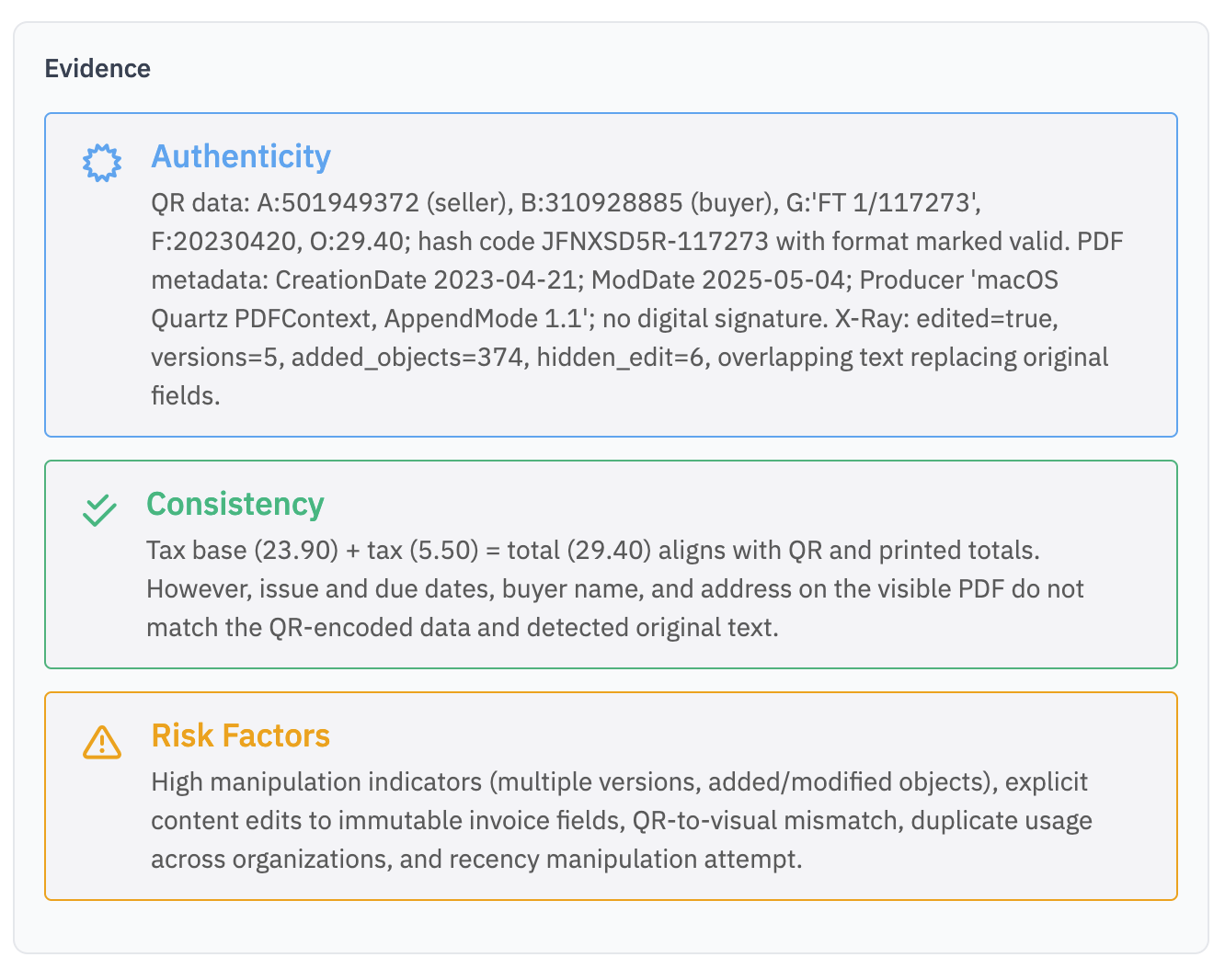
Evidence
The Evidence section organizes the supporting findings used in the analysis. Evidence can be grouped into categories such as:
Authenticity
Authenticity evidence describes findings that affect whether the document appears genuine and unaltered. This can include:
- signs of editing or manipulation
- metadata findings
- document structure findings
- public or reverse-image matches
- missing issuer signatures
- unverifiable security features
Consistency
Consistency evidence describes whether the information within the document agrees across the available sources. This can include:
- agreement between visible and extracted text
- matching names, numbers, dates, and addresses
- consistency between document fields
- contradictions between document content and metadata
- missing information required for cross-checking
Risk Factors
Risk factors summarize findings that increase uncertainty or fraud concern. This can include:
- high-risk forensic findings
- duplicate documents
- screenshots or reprocessed files
- unsupported or incomplete document submissions
- suspicious annotations or overlays
- inconsistent fonts or layout
- public availability of the same document content The evidence section should be used to verify that the final conclusion is supported by specific findings.
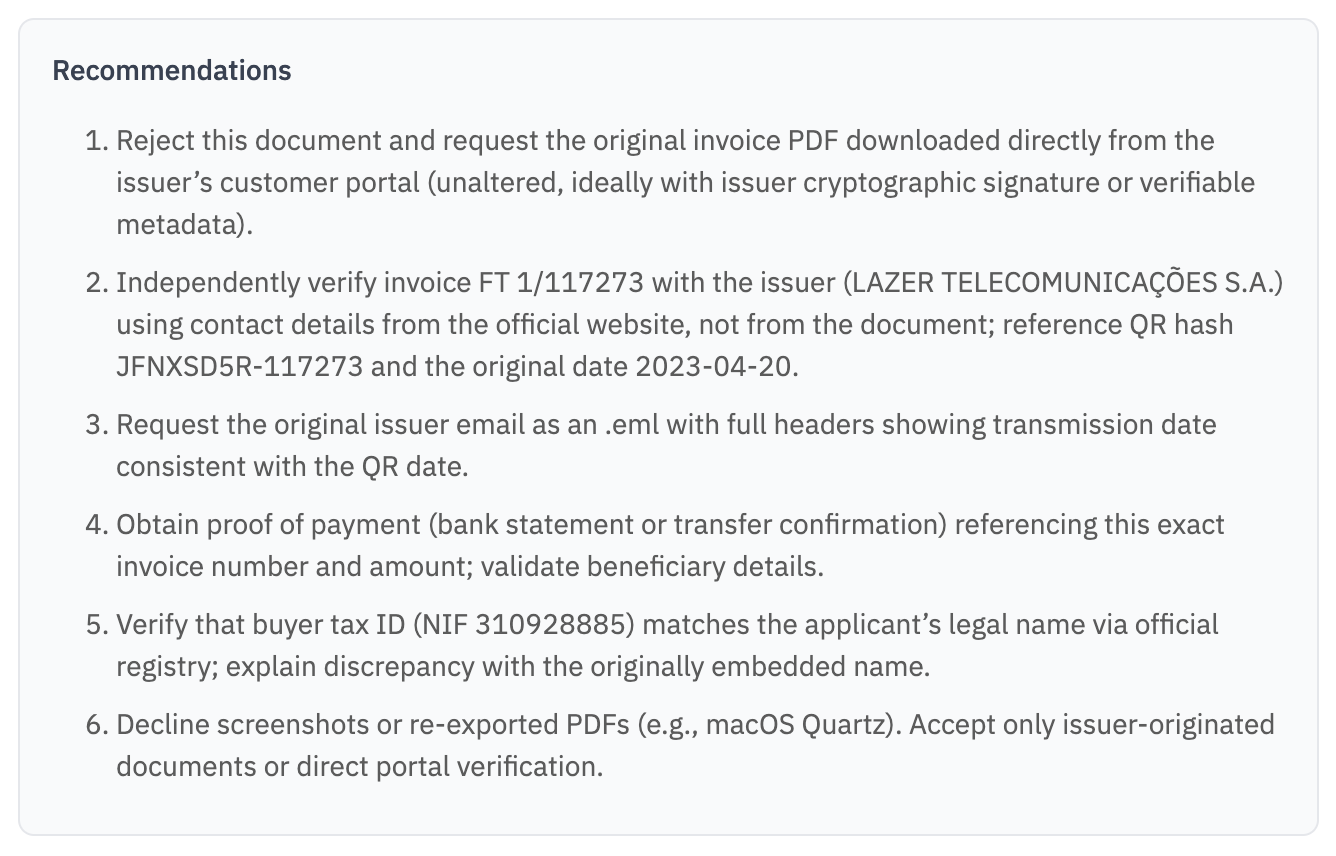
Recommendations
The Recommendations section provides suggested next steps based on the completed analysis. Recommendations can include actions such as:
- requesting a new document directly from the issuing authority
- requesting the original document instead of a screenshot or processed copy
- verifying a security feature or QR code
- requesting an alternative identity document
- performing an additional identity or liveness check
- retaining supporting evidence for case review
- rejecting documents sourced from public file-sharing services
- escalating the case for manual review Recommendations are intended to support the admin’s review process. They should be evaluated according to the organization’s own policies, risk appetite, and regulatory requirements.
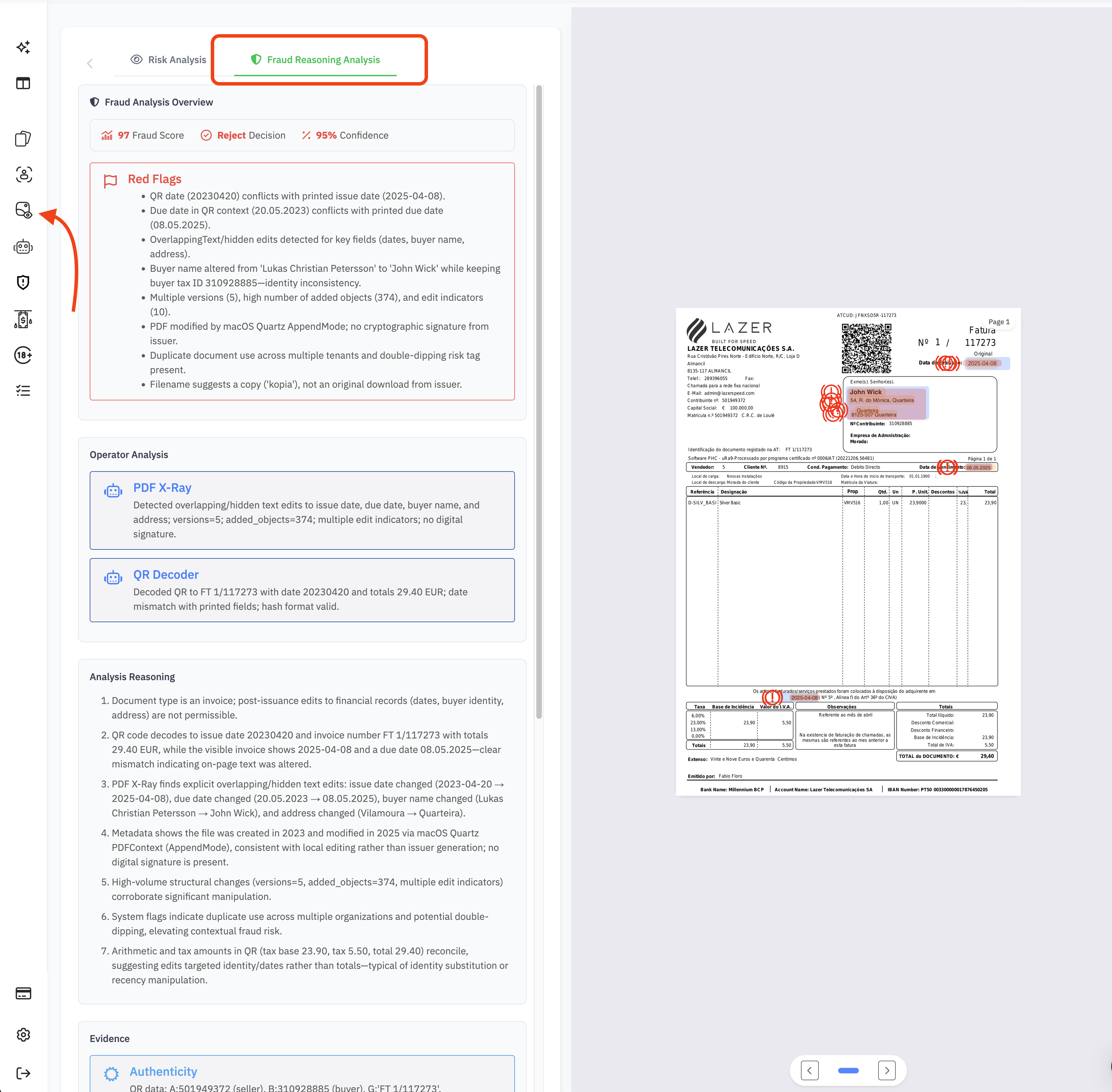
How the result sections work together
The result should be reviewed as one complete assessment. A recommended review order is:
- Review the Fraud Score to understand the overall identified risk.
- Review the Decision to understand the final conclusion.
- Check the Confidence in that conclusion.
- Review the Red Flags for the primary concerns.
- Read the Operator Analysis to understand the specialist findings.
- Review the Analysis Reasoning to understand how the findings were combined.
- Verify the conclusion against the Evidence.
- Consider the suggested Recommendations before making the final operational decision. No single field should normally be used as the sole basis for a decision. For example:
- A high Fraud Score with strong evidence and high confidence may support rejection.
- A moderate Fraud Score with incomplete evidence may support manual review.
- A low Fraud Score should still be reviewed if important red flags or conflicting findings are present.
- A high-confidence result indicates confidence in the conclusion, regardless of whether the decision is Accept, Reject, or Manual Review.
Fraud Reasoning Analysis and Risk Analysis
Risk Analysis and Fraud Reasoning Analysis are separate but complementary.
Risk Analysis presents the standard forensic and detector-based findings for the document.
Fraud Reasoning Analysis interprets the available findings, coordinates the Fraud Analysis Agents, and produces a structured conclusion with reasoning and recommendations. Admins should review both analysis views when the decision requires a complete understanding of the document.
Reviewing the analyzed document
The analyzed document remains visible alongside the Fraud Reasoning Analysis result. Admins should compare the result directly with the document, especially when the analysis refers to:
- specific text or fields
- overlays or annotations
- visible inconsistencies
- document layout
- missing security features
- duplicate content
- manipulated areas
- individual pages of a multi-page document The reasoning and evidence should be treated as review support rather than a substitute for examining the document itself.
Important considerations
Agentic Fraud Reasoning is designed to support administrative review and decision-making. The result should be considered together with:
- the original document
- the standard Risk Analysis result
- applicant or dossier information
- the organization’s internal policies
- applicable legal and regulatory requirements
- any additional verification performed outside Bynn Use Manual Review when the findings are incomplete, conflicting, uncertain, or require contextual judgment.
Updated 3 months ago